

If you’ve ever typed “should I give up on…” into a search bar late at night, you already know the problem isn’t willpower. It’s that nobody told you what specifically to change.
Most advice comes in two flavors. One camp says never give up. The other says fail fast and pivot. Both skip the only question that matters: what, exactly, isn’t working?
When you’re not hitting a goal, there are four moves available. You can change your effort. You can change your tactics. You can change your strategy. Or you can stop.
Change the wrong one and you lose months. People quit plans they never actually worked. Other people grind harder on plans that were never going to get them there. The difference comes down to one thing: running a fair test before you make a call.
The three layers people keep lumping together
Strategy, tactics, and execution are not the same thing. When something isn’t working, most people change everything at once, or nothing at all. Both are ways of avoiding the diagnosis.
Strategy is the approach, the overall bet you’re making about how to reach the goal. Get stronger. Get hired through your network. Win clients through referrals.
Tactics are the methods that carry out the strategy. Lift three times a week. Two coffee meetings a week. Ask every client for one introduction.
Execution is the doing. Whether you actually ran the tactics, as planned, consistently. It’s the only layer you fully control on any given day.
We often miss the part that each layer runs on its own clock.
Strategy belongs to your long-range goals: the life plan, the three-to-five-year picture. Tactics belong to your monthly and weekly plans. Execution happens every day. Mix up the clocks and you’ll judge a strategy on one bad week of execution, or run the same tactic for a year without once asking whether it works.
Measure two things, not one
Every goal gets two questions, and you answer them separately.
Execution: did you do what you said you’d do? This measures your effort against your own plan. It’s entirely in your control.
Effectiveness: did it get you closer to the goal? This measures whether the plan works. It’s only partly in your control. Markets shift, bodies respond on their own schedule, hiring managers go quiet.
So you score the thing you control first. Say the goal is losing fifteen pounds in three months. Your weight on the scale is a lagging indicator. It tells you what already happened and you don’t fully control it. The daily actions you planned are leading indicators. They tell you what’s likely to happen next, and you do control them. Score yourself on the leading indicators. Check the lagging one to judge effectiveness.
Your execution score is simple arithmetic. List your tactics. Count the days you did each one. Divide by the days possible. Hydrate daily at six out of seven, steps at seven out of seven, meal plan at five out of seven: sixteen out of twenty-one, or 76%.
Then the working rule. Don’t judge whether a plan is effective until you’ve executed it at 80% or better for three to four weeks, or for one full cycle of your goal, whichever is longer. Below that line, you aren’t testing the plan. You’re testing your follow-through.
Four places you can be
Put your two scores together and you land in one of four quadrants. Each has its own next move.
Stuck (low execution, low effectiveness). You aren’t working the plan, and nothing is moving. This is where most “should I quit?” posts actually come from. You can’t know whether a plan works if you haven’t worked it. Your move: work the plan. Simplify it until you can hit 80%. Don’t change tactics yet.
Ineffective (high execution, low effectiveness). You did what you planned and it didn’t move you closer. Frustrating, but useful. You’ve run a fair test and gotten a clear answer. Your move: change tactics, one at a time.
Growth (high execution, high effectiveness). You’re working the plan and the plan is working. Stay the course until you hit the goal, then set a new one.
Coasting (low execution, high effectiveness). Results are showing up with very little effort. It feels great and it won’t last. Beginner gains, a hot market, or a lucky break can carry you for a while. Your move: build the execution habits now, and raise the goal, because this one isn’t stretching you.
What to change, in what order
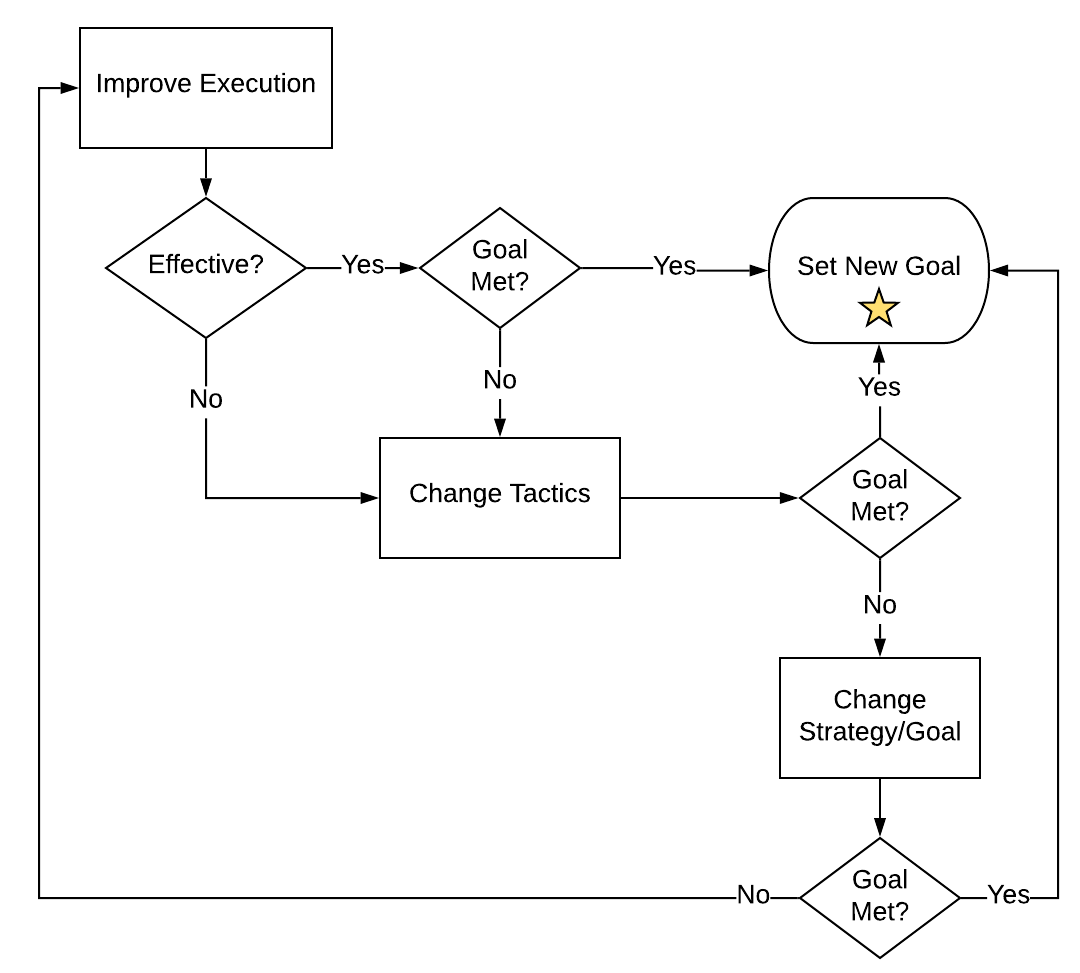
The order matters more than the diagnosis: effort first, then methods, then approach. Each step costs more to change than the one before, so you only move to the next one when the cheaper fix has been fairly tested.
Start with execution. Always. Before you question the plan, make sure you’re running it. Get to 80% or better.
Is it effective? If you’re executing well and the lagging indicator isn’t moving, the tactics are the problem. Change them.
Effective, but goal not met? You’re moving, just not fast enough. Adjust the methods before you touch the destination.
New tactics, still short? Now question the strategy, or the goal itself. That includes the deadline. A new timeline is a legitimate strategy change.
New strategy, still short? Loop back to execution with the new plan. Each loop gives you information. It isn’t a verdict on you.
Goal met at any point? Celebrate it, then set the next one.
The three levers, and how to pull each one well
Lever 1: try harder. Pull it when your execution score is under 80%, when you can name the tactics you skipped, when your best results line up with your best weeks. Pulled well, it looks like fewer tactics each one scheduled, tracked daily and reviewed weekly, friction removed the night before, someone holding you accountable. Pulled badly, it looks like adding new tactics to fix a follow-through problem. That gives you more plan and even less doing.
Lever 2: change tactics. Pull it when you’ve executed at 80% or better for three to four weeks and the needle is flat, when you’re moving but too slowly to make the deadline, or when people using the same strategy are getting results with different methods. Pulled well, it looks like swapping one tactic at a time, keeping what’s working, giving each change a full cycle. Pulled badly, it looks like changing everything at once. If it works, you won’t know why. If it fails, you won’t know what to fix.
Lever 3: change strategy. Pull it when you’ve tested two or three sets of tactics, when the core assumption looks wrong (no one’s buying, the role isn’t hiring), or when your constraints changed: time, money, health, family. Pulled well, it looks like a new route to the same goal, a new deadline, or a smaller or bigger goal. Pulled badly, it looks like switching strategies every month. That’s chasing shiny objects, and no approach ever gets a fair test.
Four traps send people to the wrong lever. Judging too soon, because two weeks is a mood and not data. Watching only the lagging number, when the scale or the bank balance tells you what happened, not why. Grading feelings instead of data, because “I feel like I’ve been trying so hard” is not an execution score. Count it. And forgetting that the timeline is a variable. Sometimes the goal is right and the deadline was a guess. Moving it is not failing.
Three people, three different answers
All three of these people asked the same question. The framework gave each of them a different answer.
Dave, a bookkeeping side business. His goal was $3,000 a month within twelve months. At month eighteen he was at $600 and ready to quit. His plan was ten outreach calls and two LinkedIn posts a week. He actually averaged two calls and one post every other week. An execution score of about 20%. He hadn’t tested the plan, so he couldn’t tell whether it worked. Quitting then would have meant walking away without any real information. He cut the plan to five calls and one post a week, numbers he’d actually hit, and committed to eight weeks. Execution went to 85%. He signed three new clients and reached $1,400 a month. Only then did his decision rest on data.
Marcus, losing fifteen pounds in twelve weeks. Weeks one through three he was down five pounds at about 55% execution. That’s Coasting: early results his effort wasn’t really producing. His move was to build the habits before the easy pounds ran out. Weeks four through eight his execution held at 81 to 90% and the scale flatlined. That’s Ineffective, so he changed tactics: three strength sessions a week and a protein target replaced the daily steps, and he kept the meal plan. Weeks nine through twelve he lost four more pounds, nine of fifteen. It was working but wouldn’t hit the deadline, so he changed the goal: same plan, deadline extended six weeks.
Priya, a job search. Her goal was a marketing operations role within four months. She sent fifteen applications a week at 100% execution. After 180 applications she had three phone screens and zero offers. She was clearly working hard, so the tactic was the problem. She switched to five tailored applications and five referral conversations a week, and rewrote her résumé around results. Within six weeks she had four interviews and one final round, but no offer. So she changed strategy: she widened her target to include contract and adjacent roles. A six-month contract turned into a full-time offer.
Notice that in each case, the person needed one specific lever, pulled in the right order.
When to walk away
There’s no quit box on the flowchart. That’s on purpose. Most people who quit do it from Stuck, before they’ve tested anything. But sometimes walking away is the right call, and it deserves the same rigor as staying.
Two questions first.
How long would you work on this to see results? One year? Three? Five? Fifteen? Most meaningful goals take longer than we hoped. Be honest about the number you’d actually accept.
Do you enjoy the work itself? Not the result you picture at the end. The actual daily work. If not, stop and find something else. If so, remember that the time will pass either way. You might as well spend it on work you enjoy.
Then check your frustration, because it comes from one of two places. Unmet expectations mean you expected to do the work and didn’t. Go back to Lever 1. Unrealistic expectations mean the goal or the timeline was never plausible. That’s a reason to reset the goal. You don’t need to give up on yourself.
Signs it’s not time yet: your execution score is under 80%, so you’re Stuck and not finished. You’ve tried only one set of tactics. You’re comparing your month three to someone else’s year five. You had a bad week.
Signs it may be time to walk away: you’ve run the full loop with high execution and it still isn’t working. The goal no longer connects to what you actually want. The cost to your health, relationships, or money outweighs the payoff. The only reason left to continue is what you’ve already put in. That’s a sunk cost fallacy.
Quitting is a strategy decision, not a character flaw
The whole point of this is to stop treating a stuck month like a verdict on your worth. You are not broken for being behind. You’re operating without a blueprint, and the fix is a diagnosis rather than more effort poured into the wrong layer.
So the next time you feel the urge to quit, or the urge to change everything, do the five-minute version instead. Score your execution over the last three to four weeks. Score your effectiveness against the pace you’d need. Plot the point. Then read your move: work the plan, change one tactic, change the strategy or the goal, or stay the course.
That’s it. It won’t tell you what your goal should be, but it will tell you which lever to pull next. Run it on a napkin. Run it weekly. Watch the line you draw between your months, because the direction you’re moving tells you as much as where you are.
If you’d like the checklists and system to work through in a workbook, you can grab it here for $3. If you’d like to track your execution online, give FocusedExecution.com a try.
Enjoy your weekend!
